Objectives
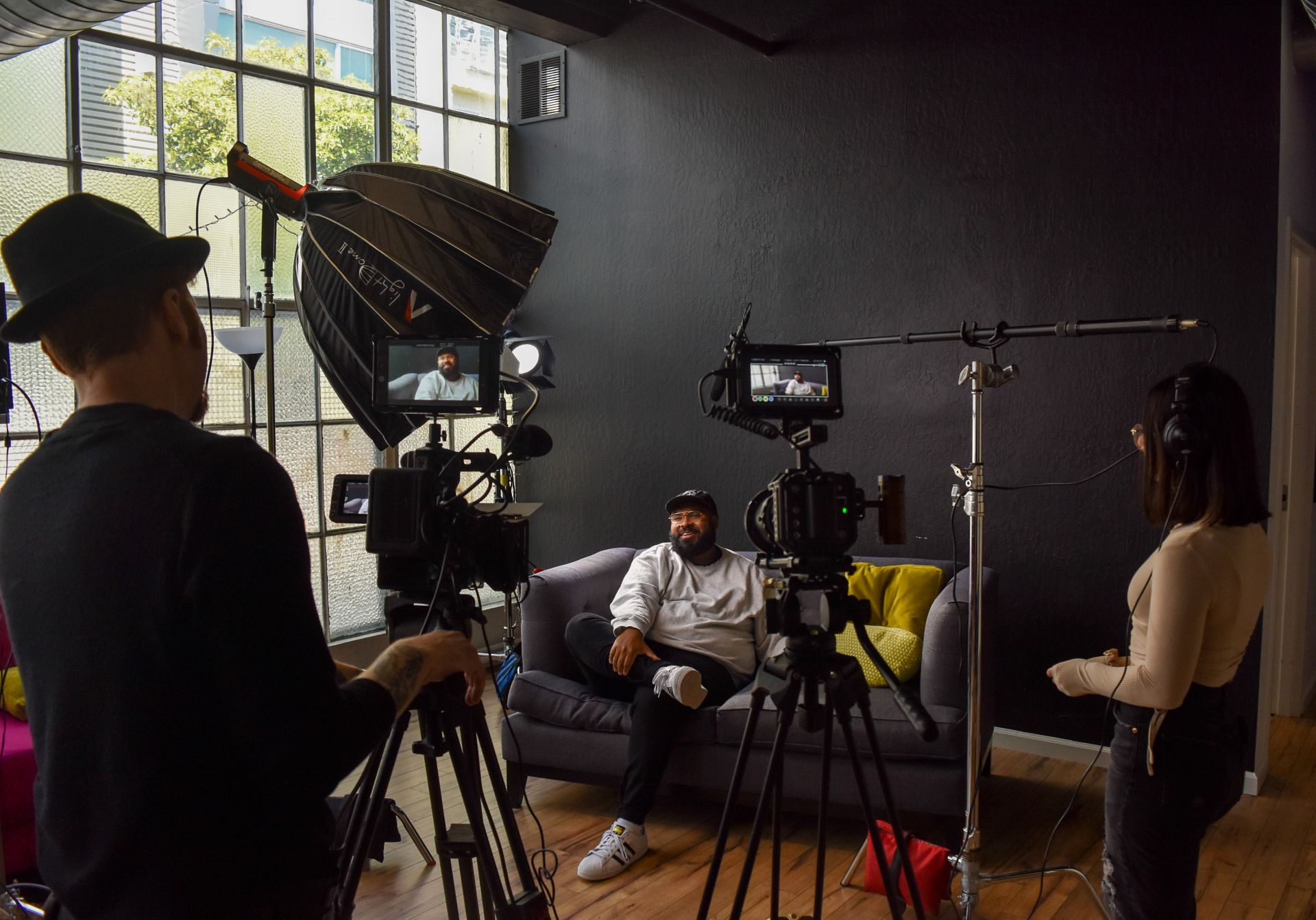
Students will be introduced to the basics of sound, microphones and field recording.
Materials/Equipment
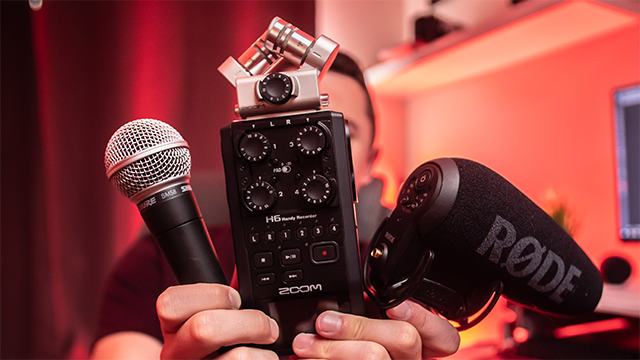
- Lavalier Microphone
- Shotgun Microphone
- Boom Pole
Handouts
Recording Sound (8.17 kB)
Lesson
Sound
Definition: Sound is an invisible vibration. It travels in
waves, spreading outwards from the source of the sound. Sounds are
different both in loudness and pitch, often known as frequency.
Loudness is measured in decibels (dB).
Pitch / Frequency is measured in Hertz (Hz).
All sounds are made up of different frequencies. We can describe
this as the pitch of a sound. The frequency of a sound affects the
pitch that it is heard at. The sound a whistle makes when it’s blown is
an example of a high frequency pitch whereas the noise made when
banging on a drum is an example of a low frequency pitch.
http://www.idcs.info/childhood_deafness/what_is_sound.html
Not only is sound half your video, sometimes sound makes or breaks a video.
It is important to know how to record sound technically, and then
also how to listen for sounds that can work creatively to enhance your
story.
Types of Audio you will be Recording
Generally, Sound for your video will include the following:
Dialogue or Voice Over, Ambiance, Sound Effects and Music. You will
need to record all of this audio and then assemble your sound design
(what kinds of audio will be part of the video sound) and then refine
your sound mix (the levels each audio element will be heard in general
and in relation to each other). Refer to Sound Design Lessons for more
on Sound Design and Mixing.
Selecting the Proper Mic:
Use an external mic whenever you can. This lets you have more control over how and what you record.
Microphones come in a variety of types. They can be directional or
omni-directional, have their own battery source or require power from
the camera etc. In addition, each make and model has its own
character. With any mic, always listen with headphones to confirm
you are recording the sound you want. You can always reposition the mic
to get what you want!
Connect each type of mic to the camera and listen to what audio is picked up.
Lavalier Mic (Lav)
Typical Use: Interviews
Characteristics: These are the small “bud” microphones that can
fasten to clothing. Although these mics are “omni-directional”, they
are specially designed to pick up the voice vibration/sounds of a
person speaking. It does not matter where the Lav is placed, as long
as it is in the general chest area (collar or front of shirt).
Tips: Try to hide the lavalier or at least the wire under the
clothes. (If you hear a rustle through the headphones, the lavalier
chord may need to be taped to the person’s skin.) Place as close to
the sternum as possible. A lavalier likes to hear the resonation in the
chest cavity.
NOTE: Each interview subject needs their own lav mic. If you have
more than one interview subject and only one lav mic, use a shotgun mic
on a boom pole instead and move the boom accordingly.
Shotgun Mic (also known as boom or stick)
Typical Use: Multiple Interview Subjects, Specific Sound, Ambient Sounds,
Characteristics: Shotgun mics are usually much more sensitive than
an on-camera mic, and pick up better sound. Shotgun mics are
directional mics and usually pick up sound in the direction the mic is
pointed. Where you point the mic matters!
Tips: For interview: Aim the shotgun mic like a gun directly at the
subject. Bring the mic in as close as possible to the subject using a
boom pole, pistol grip or stand. Overhead is usually safest, though
sometimes from under the subject is preferable, depending on the
framing of the shot. Be sure the mic is pointing in the same direction
as their path of speech- not to their nose or to the side.
To record general sounds with a shotgun mic, since the mic is
directional, aim the mic in the direction of the sound you want to
forefront. For example, if you are at a park and there are kids playing
to the right and a fountain to the left, the side you point it to will
highlight one sound over the other (to the right you will hear more of
the kids, to the left, more of the fountain, upright a combo of both
and whatever is in the sky).
NOTE: If you are recording general ambiance, if you have access to
an external omni-directional mic, use that. If not, you can cheat it
with a shotgun, by pointing the shotgun in a direction in between
sounds and listening with headphones to see if you get what you want. Omni Directional Mic
Typical Use: For general ambiance.
Characteristics: Omni-Directional Mics pick up sounds from all
directions, hence it is good for getting general (non specific) sounds.
Tips: Point the mic in the any direction, listen with headphones and
hear if this is what you want. If not, reposition the mic accordingly.
On-Camera Built In Mic
Typical Use: Used to record audio when there is no external mic.
Characteristics: Omni-Directional.
Note: Since this Mic is omni directional, it picks up sounds from
all around, sometimes including the hum of the camera. If you have
access to an external mic, it is always better to use the external mic
so you can have more control and discretion for the audio you record.
Recording Sound Techniques
Basic Checks
-
Is your external mic properly connected to the camera?
- Is the external mic power on (and the camera extra source power
off)? Or vice versa. Select one power source so you do not short
circuit the camera or mic with multiple power sources!
- Are your audio levels set? Is the audio level high enough, but not in the red?
NOTE: If you are interviewing someone, set up all your equipment and
then have your subject say a few sentences so you can meter your level
and set the audio levels to match the level of their voice. Then start
recording the interview.
Use your eyes and ears.
Use your eyes. Watch for the boom, microphone, shadow, or
boom operator in the shot! It helps to show the boom operator where
the edge of the frame is, i.e. when any of these things creep into the
shot.
Use your ears. While shooting, someone should always be
monitoring the sound. If this person closes his or her eyes, or looks
away from the scene, it may help him or her concentrate on the sound.
Listen especially for excessive sound.
Excessive Sounds: Sometimes there are sounds in the setting in
addition to what you are trying to record. Sometimes this is ok, other
times this is distracting. Listen to the situation and if it will be
too distracting, move your location or wait until the sound stops.
Some “excessive” sound elements to listen for:
Bus Lines/Traffic
Construction; Hum of Computers/Refrigerators
Street Noise; Ventilation Systems
Garbage/ Recycling Activity; Fluorescent Lights
Airplanes Traffic; Actual space: Echo, Dead or Live
Wind
Getting the sound you want and how you want it
Although there is a fair amount you can do with your sound in the
post production stage, there are some variables you need to consider in
the production stage. If there is a particular sound you are trying to
capture – for example, the sound of a particular person or object - you
need to make sure the mic is pointed at your desired primary sound
element. You must also consider how close or far you are from the sound
you are trying to capture.
Record room tone and ambient sound
Room tone is the sound of your location when all the subjects and crew hold still and silence is recorded. It has a sound to it.
Ambient sound is the same thing, but more commonly refers to outdoor sounds, the background sound of your location.
Always record at least 30 seconds to one minute of these without cast or crew making any noise, but remaining on location.
Blank audio tracks do not sound the same as silence! In editing you may need these crucial audio clips to replace unwanted sounds or fill in “sound gaps” in your edit.
Note about Ambient sounds: Are there other ambient sounds in the
environment you could record that may be used as part of your sound
design later?
Activity
Have students tell the story of a place by recording sounds that
convey the sense of the place. They can shoot visuals that
symbolically/metaphorically support the sound. Note: This is an
exercise not only in documentation of a place, but also selecting a
perspective and story to tell about the place.
|